Compliance
STURDY Act and ASTM F2057-23: a buyer's checklist for kids' dressers and wardrobes
The STURDY Act turned dresser stability into a legal requirement in the United States. For an importer, a unit that tips over in the laboratory is a unit that cannot be sold, and the importer is the party held responsible.
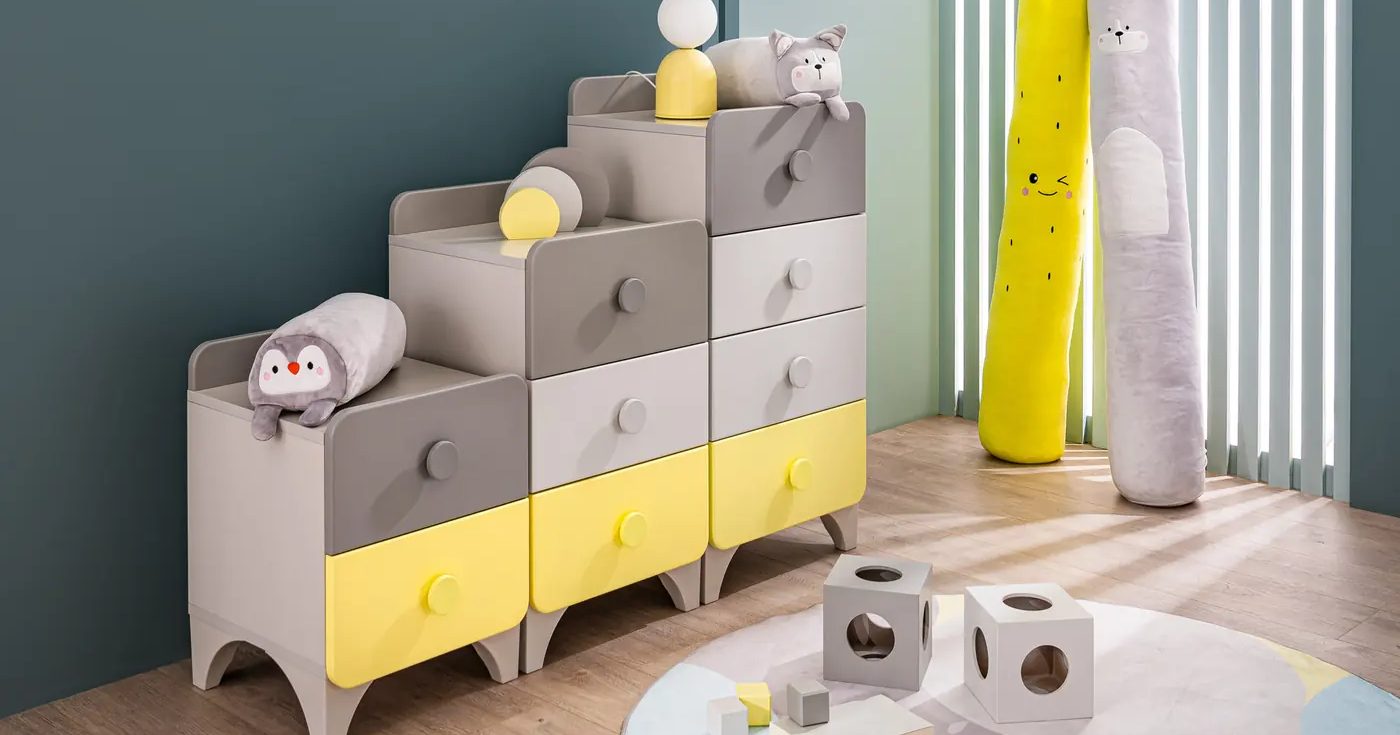
What the STURDY Act requires
STURDY stands for Stop Tip-overs of Unstable, Risky Dressers on Youth. Congress passed the STURDY Act at the end of 2022, and the Consumer Product Safety Commission (CPSC) then adopted the industry standard ASTM F2057-23 as a mandatory federal rule. It sits in 16 CFR part 1261 and applies to all clothing storage units manufactured after 1 September 2023.
The aim is to protect children up to 72 months of age from furniture that tips when they open drawers or climb on them. The rule does this by testing the furniture itself. It applies to adult bedroom furniture as much as to nursery furniture, because a toddler can reach both.
Which products count as clothing storage units
A product is in scope when it meets all of the following, as set out in the Federal Register notice:
- it is free-standing and intended for storing clothing, with drawers, hinged doors or both;
- it is 27 in (686 mm) or more in height;
- it weighs 30 lb (13.6 kg) or more;
- it has 3.2 ft³ (90.6 dm³) or more of enclosed storage volume.
Dressers, chests of drawers, armoires and door chests are the usual examples. A children's wardrobe with hinged doors is in scope if it meets the size criteria.
The CPSC guidance lists what is excluded: shelving units such as bookcases and entertainment furniture, office furniture, dining room furniture, jewellery armoires, under-bed drawer units, laundry sorting units, accent furniture not intended for the bedroom, built-in units and clothing storage chests covered by ASTM F2598.
The three stability tests in plain language
Each test must be passed by the unit standing free, with no wall restraint fitted.
| Test | What it simulates | How it is done |
|---|---|---|
| Clothing load | A full dresser with drawers pulled out | All doors and drawers not held by an interlock are opened. If half or more of the storage volume is extended, the unit is filled at 8.5 lb per cubic foot. It must not tip. |
| Horizontal force | A child pulling on the unit | A 10 lb force is applied at the highest hand-hold, up to 56 in from the floor. |
| Carpet and child weight | A child climbing an open drawer on carpet | The rear of the unit is raised on a 0.43 in block to mimic carpet, and 60 lb is placed on the edge of an open drawer or pull-out shelf. |
Many units pass by using interlocks that stop more than one drawer opening at a time. The standard sets rules for these as well. An interlock must engage without any action by the user, and it must stay closed and keep working when 30 lb of force is applied for 5 seconds.
For a buyer, the practical point is that stability comes from design: a deep base, weight kept low, drawer travel and interlocks. It cannot be added at the end with a bracket.
Labels and tip restraints
Every unit must carry a permanent warning label in a conspicuous place, with the wording and pictograms set by the standard. The adopted standard does not require a hang tag.
An anti-tip device that meets ASTM F3096 must be packed with the product. This requirement stands beside the stability tests. The CPSC states that supplying a restraint does not exempt the manufacturer or importer from the testing requirements.
CPC or GCC: which certificate applies
All clothing storage units need a certificate. Which one depends on whether the unit is a children's product, meaning one designed or intended primarily for children 12 years of age or younger.
| Children's product | General-use product | |
|---|---|---|
| Certificate | Children's Product Certificate (CPC) | General Certificate of Conformity (GCC) |
| Testing | At a third-party laboratory accepted by the CPSC | Third-party laboratory testing is not required |
| Repeat testing | Periodic testing at least every one, two or three years, and again after a material change | No periodic testing rule. The certificate is based on testing or a reasonable testing programme. |
The CPSC looks at the manufacturer's statement of intended use, the packaging and advertising, how consumers commonly recognise the product, and its Age Determination Guidelines. It also notes that most home furnishings are not usually considered children's products. A dresser sold as part of a nursery collection, in children's colours and sizes, should be planned as a children's product from the start.
The 0.009% limit on lead in paint applies to furniture in general. Children's products add the 100 ppm limit on lead in accessible components and permanent tracking labels.
What the importer of record is responsible for
US law treats the importer as the manufacturer. It is unlawful to import a consumer product that does not conform to an applicable safety rule, or to fail to provide the required certificate. Three consequences follow.
- Border refusal. Non-compliant or uncertified goods can be refused admission.
- Penalties. Civil penalties can currently reach $120,000 per violation and $17,150,000 for a related series of violations.
- Recalls. In July 2026 the CPSC announced two recalls covering nearly 27,000 imported dressers that violated the standard. Both were sold online, and both ended in full refunds.
Paperwork has also moved to the border. Since 8 July 2026, certificate data must be filed electronically at entry for imported products. The CPSC says eFiling creates no new testing or certification obligations, but it does mean a missing certificate is visible at entry.
Supplier checklist for dressers and wardrobes
- For each item, the height, assembled weight and enclosed storage volume, with a clear in-scope or out-of-scope decision.
- A test report to ASTM F2057-23 for the exact model, size and construction you are buying.
- For children's units, the name of the CPSC-accepted laboratory and the date of the last periodic test.
- A description of the interlock system, if one is used, and confirmation that it needs no action by the consumer.
- Artwork and position of the permanent warning label.
- The ASTM F3096 restraint, packed in the carton, with its place in the assembly instructions.
- The date of manufacture marked on the product, since the rule is tied to it.
- The data your customs broker needs to file the certificate electronically.
- Written agreement that any change of board, hardware or dimensions is notified before production.
Frequently asked questions
Does the STURDY Act apply only to children's dressers?
No. The standard applies to all free-standing clothing storage units that meet the height, weight and volume criteria, including adult bedroom furniture. The age of the intended user decides which certificate is needed, not whether the stability tests apply.
Does including a wall anchor kit make a dresser compliant?
No. An anti-tip device that meets ASTM F3096 must be packaged with the unit, but the unit still has to pass the stability tests on its own. The CPSC states that supplying a restraint does not exempt the manufacturer or importer from the testing requirements.
Does a wardrobe with hinged doors count as a clothing storage unit?
It can. The definition covers free-standing furniture with drawers, hinged doors or both that is intended for clothing storage and typical of bedroom furniture. If the wardrobe is at least 27 inches tall, weighs at least 30 lb and has at least 3.2 cubic feet of enclosed storage, it is in scope.
What happens if an imported dresser fails the standard?
Non-compliant or uncertified products can be refused admission at the border. If they have already been sold, the usual outcome is a recall with a refund to consumers. Civil penalties can reach 120,000 US dollars per violation and 17.15 million US dollars for a related series of violations.
Planning a range for the US market?
Send us the pieces you are considering. We will go through dimensions, weights and the test plan for each one with you before you commit to an order.
Talk to our export teamSources
- 16 CFR part 1261, Safety Standard for Clothing Storage Units (eCFR)
- Federal Register, 4 May 2023: Safety Standard for Clothing Storage Units
- CPSC business guidance: Clothing Storage Units
- CPSC FAQ: Clothing Storage Units
- CPSC: Children's Product Certificate
- CPSC: General Certificate of Conformity
- CPSC: Children's products, definition and factors
- CPSC: Periodic testing
- Federal Register: Civil penalties, adjusted maximum amounts
- CPSC news release: mandatory eFiling for certificates of compliance
- Home News Now: CPSC announces 2 recalls involving nearly 27,000 clothing storage units
- Intertek: STURDY Act final rule published
Caploonba designs and manufactures nursery, children's and youth room furniture in Torbalı, İzmir. Caploonba is a brand of Orpak Mobilya A.Ş., a furniture manufacturer since 1983.
This article is general information for trade buyers, last reviewed on 9 October 2026. It is not legal, customs or tax advice. Rules and rates change; confirm the current position with the relevant authority, an accredited test laboratory or a licensed customs broker before you rely on it.
Keep reading
EUDR furniture rules: what to ask your supplier before 30 December 2026
The EU Deforestation Regulation applies to wooden furniture from 30 December 2026. Who files what, which data to get from your supplier, and a questionnaire.
Sourcing furniture from Turkey: duties, transit times and what buyers should expect
A buyer's guide to sourcing furniture from Turkey (Türkiye): export figures, duty treatment by market, transit times to Europe and the US, and the risks.